The Problem With Waiting Until Monday Morning
Imagine a potential customer landing on your website at 10 p.m. on a Friday. They have a question, they're ready to move forward, and there's no one available to help them. So they close the tab and try your competitor instead.
This happens more often than most small-business owners realize. People browse when it's convenient for them — evenings, weekends, lunch breaks — and if your site can't respond in that moment, you're likely losing leads that were already halfway to becoming customers.
An AI chatbot changes that equation entirely. It doesn't clock out, it doesn't get tired, and with the right setup, it can have a genuine, helpful conversation that moves a visitor from curious to qualified — all without you lifting a finger.
What an AI Chatbot Actually Does (In Plain Language)
Let's clear up a common misconception. An AI chatbot for lead generation isn't a rigid script that makes visitors click through a frustrating menu of options. Modern AI-powered bots use natural language processing to understand what someone is asking and respond in a conversational, human-feeling way.
For a small business, this means the chatbot can:
- Greet visitors and ask how it can help, matching the tone of your brand
- Answer common questions about your services, pricing ranges, location, or turnaround times
- Ask qualifying questions — like project budget, timeline, or the type of service needed — to understand whether someone is a good fit
- Collect contact details such as name, email address, and phone number in a natural, low-pressure way
- Route hot leads by sending an immediate notification to you or your team
- Schedule calls or appointments by connecting to your calendar
The result is a visitor who came in cold and leaves having shared exactly what you need to follow up effectively.
Why Qualification Matters as Much as Capture
Capturing a lead and qualifying a lead are two different things, and both matter. A lead capture that only grabs an email address can leave you spending hours chasing people who were never a good fit. Qualification changes that.
When your chatbot asks a few thoughtful questions before passing someone along — What kind of project are you working on? What's your rough timeline? — you arrive at every follow-up conversation already knowing the basics. That saves time for you and creates a better first impression for the customer, who doesn't have to repeat themselves.
What Good Qualifying Questions Look Like
The right questions depend on your business, but a few principles apply across industries:
- Keep it short — three to five questions is usually plenty
- Ask about need, timeline, and budget in a gentle, open-ended way
- Avoid anything that feels like an application; the tone should be helpful, not interrogative
- Confirm the best way to reach them and when
A good chatbot feels less like a form and more like a brief, friendly conversation with your receptionist.
Setting Up for Success: It's About the Configuration
The technology itself is only part of the equation. A chatbot that hasn't been configured thoughtfully for your specific business can frustrate visitors rather than help them. This is where working with someone who understands both the technical side and your business goals makes a real difference.
Here's what a well-configured lead-gen chatbot needs:
- A clear purpose — it should focus on one or two goals, not try to do everything at once
- Your brand voice — the language should sound like you, not like a generic template
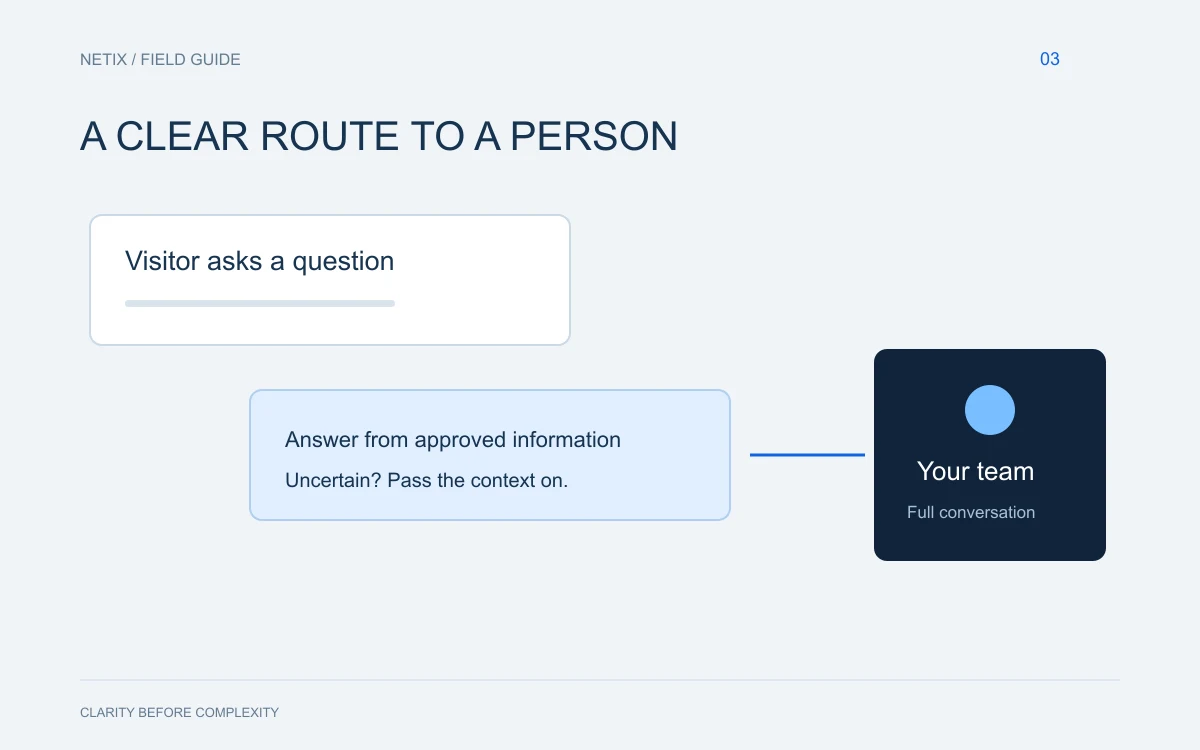
- A graceful handoff — when someone has a question the bot can't handle, it should offer to connect them with a real person rather than leaving them stuck
- Integration with your CRM or inbox — leads captured by the bot need to flow somewhere useful, not disappear into a void
- Regular review — chatbot conversations are a goldmine of information about what your customers actually want to know
Real Benefits Beyond Lead Generation
Once you have a chatbot running, you'll likely notice a few benefits you didn't fully expect. Repeat questions — the ones your team answers over and over — get handled automatically. Website visitors stay engaged longer because they're getting immediate responses. And your team can focus their energy on the conversations that actually need a human touch.
For businesses in service industries especially — contractors, consultants, agencies, medical offices, real estate professionals — this kind of always-on responsiveness can meaningfully shift how many inquiries convert into actual clients.
The most important thing to understand: an AI chatbot isn't a replacement for your people. It's a tireless front-line tool that makes sure no opportunity slips through the cracks while your team focuses on doing the work they're best at.
Getting Started Without Overcomplicating It
If you've been putting off adding a chatbot because it sounds technically overwhelming, it doesn't have to be. A focused implementation — one with a clear goal, the right questions, and solid integration with the rest of your website — can be up and running faster than you might expect.
At Netix Solutions, we help small businesses nationwide build websites and digital tools that actually do the heavy lifting. If you're curious about whether an AI chatbot could work for your business, we'd love to talk it through with you. Reach out anytime — we're pretty good at being responsive ourselves.